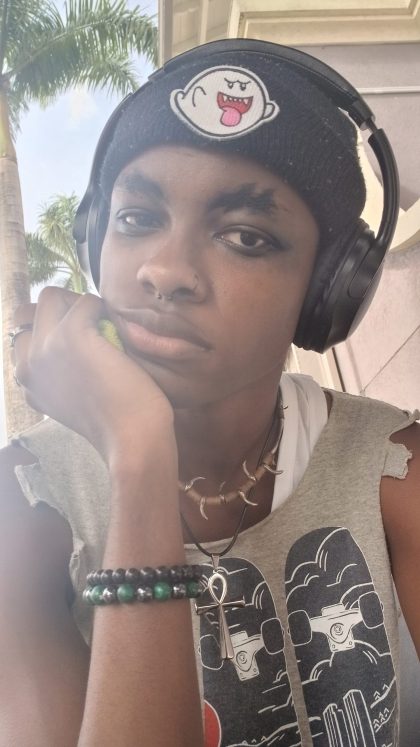
What sparked your interest in art?
I never took art seriously when I was little, but I loved watching cartoons and superhero shows. Growing up, we didn’t have that much. They weren’t always available to me. So when I couldn’t watch anything, I would spend a lot of time daydreaming or constantly rewatching the DVD sets I had, like Ninja Storm or Young Justice.
They only had so many episodes, so when it reached the end I would make up all these little storylines in my head and act them out in the yard by myself to kinda fill in the gaps. Or play out all my favourite scenes. I had so much fun. It was great.
As I grew, I started to gain access to what more was out there, like anime. But I never thought art could be an option for me. Then everything changed when the Fire Nation attacked (literally).
I met a friend in secondary school named Daniel and he was one of the most incredibly artistic people I’ve ever met. He was a great friend and he could create amazing things so naturally, which inspired me to learn so [that] I could truly see what I myself could be capable of.
Who are your influences and what have you learned from them?
My influences come from anyone I find interesting and beautiful, high profile or not. But who particularly influenced me the most?
- Yusuke Murata: I learned a lot about anatomy, dynamic posing, objects in motion and action from his work on One Punch Man.
- Atsushi Okubo: He made Soul Eater, which is one of my favourite anime, and his artstyle spoke to me because of how colourful, expressive and simple it is. It allows him to exaggerate proportions and poses, which elevates the story he’s trying to tell. It gives him more freedom rather than worrying about detail or overly accurate anatomy.
- Francisco Goya/Franz von Stuck: I put these two together because I get the same thing from each of their work. They have a bunch of artwork that’s very dark. And I love it because of their willingness to explore the darker side of life (like Saturn Devouring His Son) even if that truth makes people uncomfortable. If we don’t confront these things, then we cannot change anything. So I try to show that in my work.
What do you think makes you unique as an artist/creative?
My passion and the fact that no one can see the world the way I do. That’s the fun part. And it goes for all of us.
People think an idea has to be unequivocally original or never done before to be worth executing, but that originality still has to come from somewhere. You just need to find another perspective. Cloverfield is the only movie of its kind, but all J.J Abrams asked was: “What if we take Godzilla, make it American and film it from a civilian’s POV?”
Chronicle is the only movie of its kind, but even that was influenced by movies like Carrie and Akira. What if for a superhero, we gave a teenager spider powers, but then gave him real life problems? As if that’ll ever work.
What do you ultimately want to achieve with your work?
My work is for the voiceless, the silenced and the unheard. It amplifies them. It shares their struggle, but recognises their resilience; transforms statistics into stories, because that’s what connects us. It’s my great power and responsibility as a storyteller.
I want to change the world; make it a kinder one. And I want to inspire people not just to embrace being different, but to have the courage to be more than they or anyone thinks they can be.
What’s the most rewarding part of being an artist or creative?
The most rewarding part is being able to show what my passion looks like and what form it takes, sharing how I see the world and leaving room for people to connect with it, [and] creating a new beauty that I can distribute.