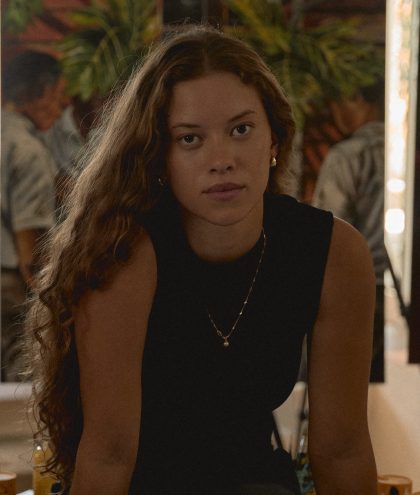
What’s a defining moment that shaped you as an artist?
During university I had to create two life size head sculptures. It was one of the most passionate pieces I think I’ve ever worked on. I spent hours on them every chance I got, often between classes and during breaks, canceling weekend plans and working late into the night until the studio closed.
Not because I was behind schedule but because I wanted them to be perfect. When I enter that state with my art I can’t focus on anything else, so I would turn my phone off, listen only to music and fully immerse myself in the process.
There were moments when my hands were moving so fast I couldn’t step away, time slipping by without me noticing and even though my hands were dried and cracked from clay, I felt completely at peace. I realized I wouldn’t want to be doing anything else but working on that sculpture.
That experience taught me the importance of dedication and how creating alone can become a dialogue between the artist and the piece.
Who are your influences and what have you learned from them?
My work is influenced by several key figures who have shaped both my style and my approach as an artist.
Even though I primarily work in realism, I sometimes draw inspiration from Egon Schiele’s expressive lines and gritty painting style, particularly when exploring the texture of skin. Observing how he pushes contrast and intensity encourages me to experiment carefully within my own realistic approach.
I’ve had the privilege of being mentored by Shane Eastmond, someone I’ve looked up to for many years. He’s taught me that being an artist isn’t just about the finished work, it’s about who you are while making it. From him, I’ve learned to trust my own process and to value myself as an artist just as much as the art I create.
I am also deeply influenced by my grandmother, with whom I spent many summers in Antigua. She instilled in me a passion for art, discipline, and hunger for success. From her, I learned the importance of mastering technique, following the rules of the craft and approaching art with dedication and care.
How would you describe your artistic style or creative approach?
My art style fluctuates between realism and expressionism. In my early years of doing art I’ve pushed myself for perfection, but over time I’ve learned to embrace imperfection, letting the work gain character by giving up some control. I enjoy creating the juxtapositions of dark shadows and bright highlights clashing to form drama and intensity. My process usually begins with sketching and studying the subject, once I know it is perfectly sketched I build on the layers of paint onto the canvas.
Are there recurring themes in your work? If so, why do you keep coming back to those themes and how do you approach them differently each time?
One theme I always come back to is faces. I’m genuinely curious about people and the depth they carry, and there’s something powerful about trying to capture that in a painting. I’m especially drawn to the eyes, because they reveal so much without saying anything.
Each time I approach a face, I look for something different in each face, whether it’s a feeling, a story or a small expression that makes that person unique. I don’t want to repeat the same portrait over and over, I want each piece to show a new angle of who someone is, or even who they could be. That curiosity is what keeps me returning to this theme.
What do you ultimately want to achieve with your work?
What I ultimately want to achieve with my work is for emotion to be felt through it. I can be guarded with my feelings, even though I feel deeply, but in my art I try not to hold back, striving to evoke emotion and create a powerful experience for the viewer.
I also hope to see my art reach new heights, but I’m a firm believer in not talking about what I’ll do until I’ve accomplished it. I want to continue working hard, building on my progress, and pushing my art forward, all while staying true to myself and keeping my work authentic.