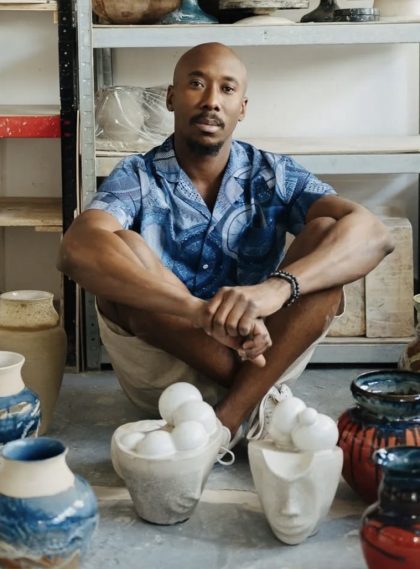
What’s a defining moment that shaped you as an artist?
My journey into ceramics began at home. Both my parents worked with clay, so it was my first introduction to art. But the true bond with the material formed later, when I began using clay as physio therapy to help regain mobility in my left arm. That experience turned clay into more than a medium; it became a tool for healing, a source of patience and discovery, and the heart of my practice as a ceramic artist and tutor.
What do you consider your best work? Why?
I consider my Planetary Collection my best work. The idea began in 2010 while I was studying product design at Ravensbourne University, inspired by my love of futuristic architecture and a deep fascination with planets and the celestial.
I didn’t make the first clay prototypes until 2020. They were smaller and simpler and over the past few years the collection has evolved in style and scale. I love the finished surfaces and contours, but most of all I love creating the forms and assembling them; it feels like composing a small universe.
What do you think makes you unique as an artist?
Being born into pottery made me become very critical of my work. Although I’ve worked with clay most of my life, I didn’t initially consider myself an artist. After meeting other artist and design peers and seeing how they worked and came up with ideas and concepts, I recognized how deeply I dive into research, reflection, and connections before creating or releasing pieces. I eventually adopted the title [of] a ceramic artist.
For you as an artist, is there a work of art or an artist that resonates with you on a profound level?
Magdalene Odundo resonates deeply with me. Her elegant, tactile forms and restrained handling of volume and surface reflect how I think about contour and presence. My earliest and most profound inspirations, however, come from my parents: Yvonne Greenidge and Hamilton Wiltshire.
My mother often made figurative sculptures; a particular head and bust from my childhood still lingers in my memory. My father’s throwing skills and glaze expertise pushed me to develop my wheel work and my love for glaze formulation.
What do you ultimately want to achieve with your work?
Ultimately, I want my work to evoke presence, to make viewers feel the tactile life of an object, and to communicate emotion. I want people to engage with my art, not treat it as a mere object on a shelf, but as something that creates an atmosphere and invites thought and reflection.