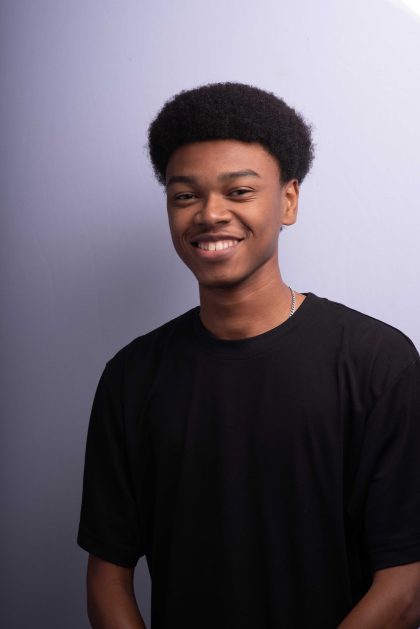
When/How did you realise that you wanted to pursue visual art?
My father is an art teacher, so growing up I was always on the ground surrounded by loose pages making stories and characters. Art stayed with me; it was how I took notes, it was how I conveyed my thoughts, and it was how I spent my time. I would say, however, it wasn’t until secondary school [that] I made an effort to improve my technical and storytelling skills.
I don’t think I really ever decided I wanted to pursue visual arts, but rather, I just did. And over the years I began to understand what it meant to create art.
Who are your influences and what have you learned from them?
From a young age it was my father. Anything I drew I tried to make look like his work. Even now, as I mature, I can see hints of his style through my own no matter how much it has changed.
Aside from him I am drawn to the work of Kim Jung Gi, J.C Leyendecker, Skottie Young, Ahmed Aldoori and Soroush Barazesh. These artists I wouldn’t say influenced, directly, my style of art, but more so [my] ideals and instilled in me the idea of consistent practice and experimentation.
Allow yourself to create before you judge the quality of your work because it [is] easy to get stuck in picking it apart before it is fully realized.
What would you say is the best decision you’ve made as a visual artist thus far?
The best decision I have made, this is challenging. Really, I would say putting myself in a position where I met other artists who challenged me and made me realize I wasn’t all [that] I thought I was. For me that was going through school, meeting other students and tutors, but this is not the only path where you can do this. [It’s] far more important the connections you make than the place you go to get them.
How do you know when something is finished and doesn’t need any more work?
This is interesting because as an artist it never really feels finished. There are always new ideas, new techniques that you learn or simply a new way of thinking that makes you want to change the piece entirely.
For me it’s usually a time constraint that forces me to stop. Or when I start to get tired of a piece, I know I need to get it to a point of completion before it’s put down for a long time.
Ultimately you have to use your technical judgement to recognize that while this can be taken further, it is good at this stage.
What do you ultimately want to achieve with your work?
With my work I’d like to tell stories and make people laugh and consider. I’d like that when people look at my work they can relate to some level. I’d just like to connect.