In a nutshell, what is the story of Loose Change?
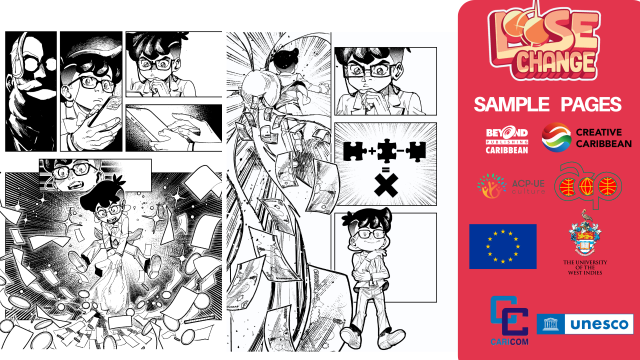
Loose Change is a psychological thriller set in a prestigious business school where students are evaluated on their ability to make money and start powerful businesses. Think an animated Shark Tank with a visual appeal children would enjoy.
Loose Change takes place in a unified Caribbean Union where the private and public sector pooled their resources to create Monarch, a school that gathers the best and brightest from the region and teaches them on the ways of wealth.
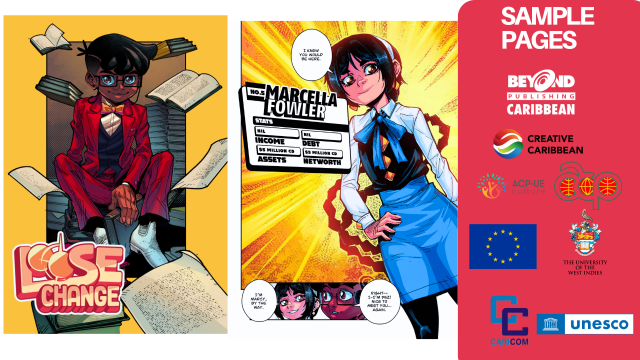
Desmond ‘Dez Holdipp (age 11) is a genius boy with humble roots who enters Monarch to repay his mother who struggled to make sure he received an education.
Marcella ‘Marcy’ Fowler (age 12) is a creative girl from the wealthy Fowler family, who have a long history of starting powerful businesses. As the third sibling to enter Monarch, expectations are high for her, but she aims to express herself through creative ways to make money.
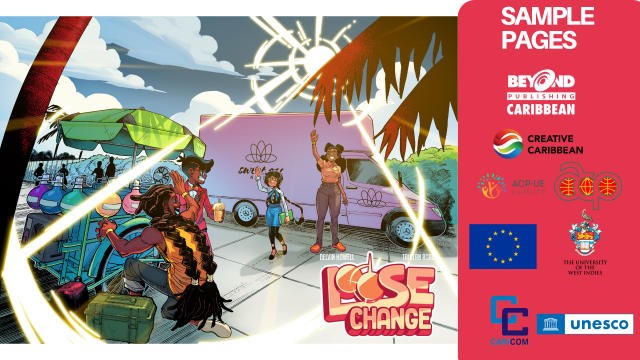
Dez and Marcy will be rivals pushing each other to improve while competing in term trials centred around commerce, including turning a snow-cone vendor (Romario) & nail salon (Sherri) into lucrative enterprises worthy of investment. Loose Change will capture themes such as the spirit of entrepreneurship, teamwork, and the realities of wealth creation, while presenting them with vibrant, bombastic visuals and emotional storytelling.
The goal of Loose Change is to teach readers financial literacy and about entrepreneurship. This isn’t the first time that Beyond Publishing has used comics as a medium for education. Why explore financial literacy and entrepreneurship this time around?
Our previous project Crossroads, which was done in collaboration with the U.S Embassy, was focused around various societal ills (bullying, gun violence, domestic abuse and human trafficking).
We managed to do three issues of this project, and it was a great opportunity to help our community with our talents.
As someone with a background in the financial sector, I noticed the need for financial literacy on all levels. For clients, they would understand the options available for them to build wealth for themselves and their families. For financial institutions, they would be able to offer their services to a bigger market. For the nation, it would empower citizens to manage their budgets and even pursue entrepreneurship to benefit their community and economies.
I also noticed a phenomenon in the Japanese market where the popularity of sports comics led to increased enrolment in those sports clubs. Eg. Haikyuu — the volleyball manga led to large enrolment numbers in volleyball clubs during its run. I saw this for multiple sports and niches in the genre, but I never saw any for finance, so that solidified the decision.
Also, unlike Crossroads and our other social outreach books, the emphasis wasn’t just on awareness for this project. Loose Change is designed to be read with the same gravitas as our other titles where the focus is on entertainment and storytelling, but on the back end the audience will learn about financial literacy. Balancing the information, visuals and storytelling was the challenge we welcomed with the project.
Loose Change is inspired by Japanese manga, particularly “non-battle battle shonen”. Could you explain what that is for readers who are unfamiliar with manga? And why is that the format you chose for Loose Change?
Traditional battle manga have narratives driven by a series of physical conflicts which the hero must overcome to achieve their goal. They [are] also usually based on themes such as effort, competition, teamwork and victory.
This is due to the influence of sports manga during the creation of Dragonball in the 80s, which allowed the child Son Goku to face hulking opponents and succeed despite the size difference, and as such influenced an entire genre of comics. While Jojo’s Bizarre Adventure introduced a tactical element with its unique structure and magic system. Popular battle manga include Naruto, Bleach, One Piece, Hunter x Hunter and so forth, and some of our titles are influenced from this genre, especially my other series, Offset.
Non-Battle manga have the same tenets of effort, competition and teamwork, but they tend to focus more on the tactical element as they don’t rely on violence to frame the conflicts in the story. Each confrontation is a battle of wits and will within the context of the narrative. These are closer to psychological thrillers in fiction and some famous examples of these are Death Note, Hikari No Go and Food Wars.
As a creator I am deeply familiar with the battle manga structure, however, I wanted to challenge myself with a non-battle story where I can step away from fight choreography and focus more on the emotions and strategy of the set piece. When working on Loose Change, I drew influence from series like Shark Tank and The Apprentice and saw the intense conflicts between hopeful entrepreneurs and powerful, indifferent millionaires. This along with the cut-throat nature of business made the perfect arena to set the series in.
The next challenge was to communicate these “battles” in a vibrant and appealing way that even a child can enjoy. So, we started to apply many of the lessons learnt and applied from our other titles and the battle comic genre itself to do so.
Are there any specific manga titles that inspired Loose Change, or does it just take inspiration from that type of manga generally?
There are tons of influences in our stories, but we wanted to reach certain metrics in terms of tone and visuals. Popular non-battle manga with an educational element such as Dr. Stone (with integrated science) was the benchmark. Blue Lock (a soccer manga), had the audacious tone we were aiming for to set the series in.
School of Judgement was a good example of the type of story with child protagonists handling adult subject matter (litigation and court drama). And visually, I wanted the surrealism and page design of Shiori Experience (a manga around rock music).
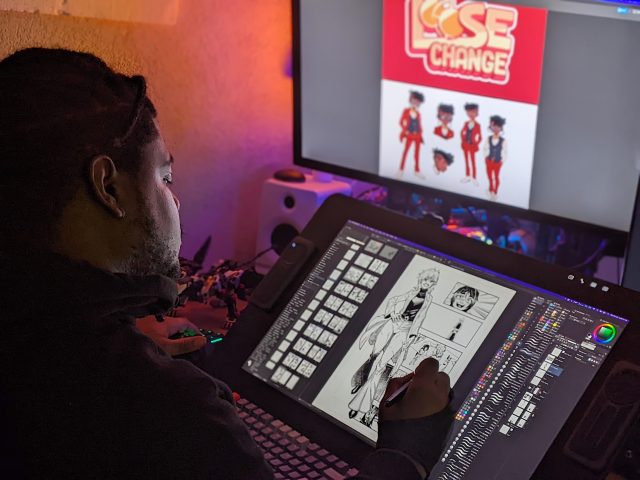
There were other visual influences which Tristan Roach (co-founder and illustrator) aimed for as well, such as Studio Trigger works (Kill la Kill, Promare), My Hero Academia, Witch Hat Atelier and Air Gear just to name a few.
The general idea was to make Loose Change be on par [with], or even surpass, what was being done in this genre by thinking outside the box and making the best decisions that would lead to deep emotional impact.
You drew on local influences as well when creating Loose Change. The protagonist Desmond “Dez” Holdipp, for instance, is inspired by King Dyall. What else inspired the comic?
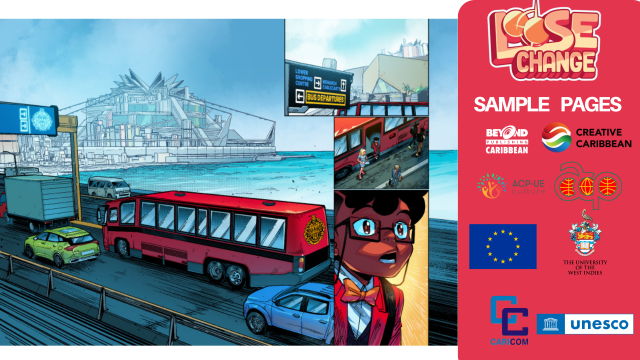
Despite the aim to compete with several Japanese titles, Loose Change is without a doubt a Caribbean story. First, it is set in a vision of the Caribbean many lamented not having; where every island came together as one and moved towards the globe in a unified fashion. In this timeline, 80 years have passed, which led to the events of the Loose Change story.
We played with the idea of legacy with traditional Caribbean names having the gravitas of old lineages and used Caribbean iconography to display it. For example, there are four powerful families that have been established in this alternate history, the Boahvells (Snake), the Gullops (Pelican), the DePinzas (Crab) and the Fowlers (Yard Fowl).
We fashioned these traditional animals into unique coat[s] of arms and other regalia to demonstrate prestige. The Fowlers, in particular, to whom Marcy belongs, is a juxtaposition of the yard fowl, which is usually associated with poverty or rural areas, but [is] framed as a symbol of wealth and prosperity.
There are many details like that within the story, but I won’t spoil all of them here.
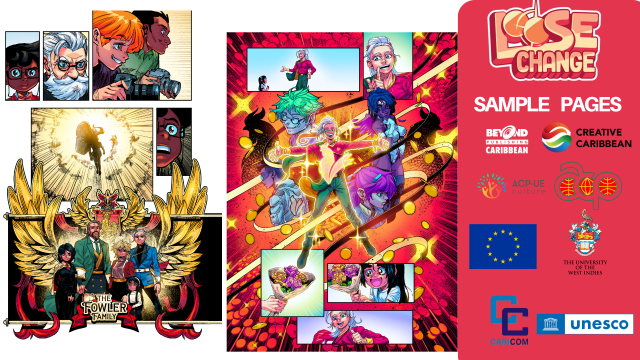
We also reference traditional Caribbean life early on through the characters. For example, Kathy-Ann Holdipp, Dez’s mother, is a street hawker so we show her doing odd jobs such as selling produce, cleaning fish, etc. Some supporting characters do traditional Caribbean jobs such as selling snow cones, and we have many nods to familiar settings and figures throughout the region, not just Barbados.
“We also hope this would appeal to those looking to venture into entrepreneurship. Whether they are starting a side hustle or have the next big idea…”
You’ve done a fair bit of research in creating this comic. What was your research process, what did you learn, and how did you incorporate that into Loose Change?
Initially, we started looking at many books from self-made millionaires, CEOs of powerful companies, etc (just like the characters in Loose Change lol). However, I also saw the series as a means to tackle the idea that you can make money doing anything, no matter how humble the profession may seem.
This led us to consider the snow-cone vendor and nail salon, and research many businesses in those industries that have become powerful brands and models for building revenue.
By a stroke of luck, we encountered several persons applying the strategies we were researching here in Barbados. So, I met with them and gained first hand knowledge of their product and services along with the advantages and disadvantages of their models. Many of which [were] weaved into the story and characters of the story.
How is Loose Change different from the other work you’ve done at Beyond Publishing, especially the comics with an educational purpose?
Many of our previous titles focus on Caribbean culture through the lens of Caribbean folklore around multiple genres such as fantasy, adventure, sci-fi, horror and action. This presented something fresh but also familiar for audiences who never saw ourselves represented in these stories on this level, whether it’s in comics, film, animation or gaming. Loose Change continues this trend, but tackling the psychological thriller and the aforementioned non-battle comic genre.
With Crossroads and our other educational series, the focus was more on awareness as collaborative projects with other entities to highlight the topics at hand. Loose Change is designed with entertainment as the focus. We want audiences to enjoy a great story on the front end, just like our other titles, but hopefully learn something on the back end.
This philosophy is in every detail of the project and designed from the ground up to achieve this result.
Who is Loose Change for? What specific demographic are you looking to capture?
Loose Change is aimed for readers age 7 and up. We were determined to design the story to have a wide reach. The vibrant visuals and page design would excite young readers, especially those who love popular animated shows. While the story does not talk down to them either, we treat the events with the same tension they and older readers would expect from those series or films.
We also hope this would appeal to those looking to venture into entrepreneurship. Whether they are starting a side hustle or have the next big idea, we framed some of the characters and their arcs with the same heroic flair as we would our other titles.
What can readers expect from Loose Change?
Loose Change Volume 1 covers a five-chapter arc over the span of 150 illustrated pages.
Chapter 1 introduces our main protagonists Dez and Marcy on their first day at Monarch, the school that breeds Millionaires, along with the circumstances that brought them there. Readers will also be introduced to a brief history of the Caribbean in this story and how Monarch came to be.
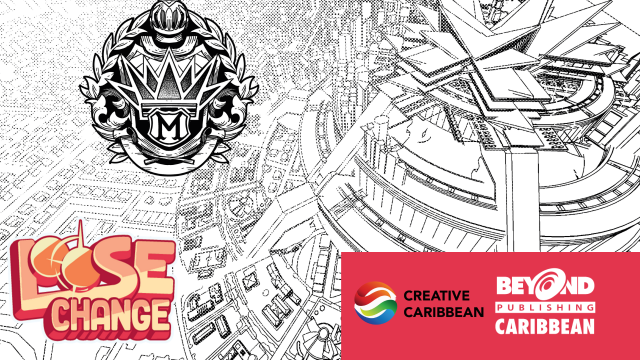
Chapter 2 will feature the first trial where first-year students must compete to enrol in the Executive Class: a class that specializes in rearing the future CEOs of the region. To get in, Dez, Marcy and the other students must learn about Income, Expenses, Net Worth and specifically the difference between an Asset and a Liability within the environment of the school.
Chapter 3 features the next major exam for the Executive Class—where they must become a patron of a small business that is showcased during the annual regional Monarch Expo, and pitch that business to a panel of powerful investors. This chapter also introduces two supporting characters, Romario Gittens (a snow-cone vendor) and Sherri Bascombe (a nail technician) who Dez and Marcy will [patronize] and aim to transform their small enterprises into powerful Turn-Key Businesses.
Chapter 4 will have Dez and Marcy team up with Romario and Sherri as they learn the business models of a snow-cone vendor and a nail salon. The models will be broken down into four fundamentals known as the 4 Ps: Product, Placement, Pricing, Promotion. Showing that despite these businesses being different from each other, they all have to consider and optimize the same things to become a powerful enterprise.
Chapter 5 will be the climax of the arc, where Dez and Marcy must pitch the two businesses to a panel of investors who will pick apart the flaws of their business models based on their experience and expertise in various fields. This will be a tense and visual experience on par with the show Shark Tank or The Apprentice.
The first volume is 150 pages and five chapters covering one arc. How many volumes of Loose Change are you planning to produce? Do you have an intended end point?
We would like to follow Dez and Marcy’s story all the way till they graduate from Monarch. Each arc would follow the school year at monarch so between 6-12 volumes would be great. We designed Volume #1 to read as a standalone arc with hints at a larger plot going forward, and this trend would continue so readers can always hop on at any time.
But for now, we are focusing on making this first arc the best experience it can be for readers.
You are a recipient of the Creative Caribbean grant, which supported the making of Loose Change. What was the process like for you as a grantee and how did the grant impact the project?
Yes, the Creative Caribbean grant was instrumental in making Loose Change a reality and to allow us to release an entire arc at once. On the production side, we tend to release chapters once or twice a year and there are always projects that take priority over others. As groundbreaking as the Loose Change series is, we wouldn’t be able to work on it until our other titles were advanced to satisfy demand.
However, through the Creative Caribbean project, it gave us the resources to alleviate that issue, and to optimize production without sacrificing quality. From a creative front, we were able to push ourselves to meet all the benchmarks we wanted within the limitations set for [us]. This was a great boon for our production pipeline going forward.
Also, the subject matter of Loose Change, which includes deep study of powerful business models from across the globe, allowed us to look inwardly at our own business model. It really created a merry fusion between creativity and commerce.
What are your aspirations for this comic?
We want people to have an enjoyable read. Like all our titles, we focus on entertainment first and foremost, along with showing audiences something they don’t normally see. Whether that stretches the boundaries of Caribbean storytelling or take[s] a fresh approach to classic genres.
I am also curious how the educational material is translated [into] the narrative; if readers, especially children, can retain the financial information and even have some excitement towards entrepreneurship.
I think if we meet those metrics, we would’ve succeeded in what Loose Change is trying to do.